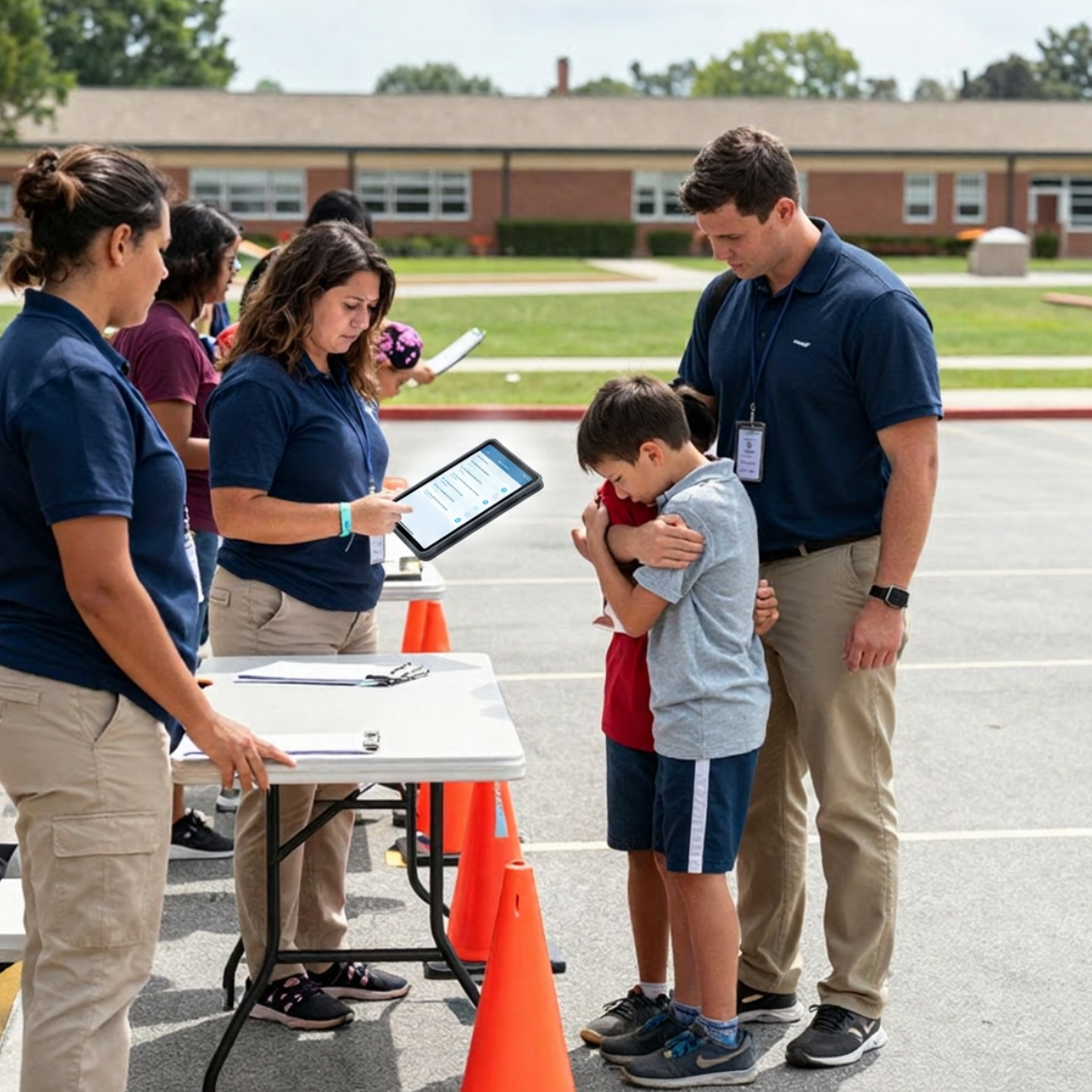


When an emergency disrupts the normal school day, the priority is always the safety of students and staff. However, once the immediate threat has been addressed, schools face another critical responsibility: reuniting students with their families in a safe, organized, and accountable manner.
Understanding how school emergency reunification works is essential for school leaders, safety teams, educators, and parents alike. Whether the incident involves severe weather, a building evacuation, an active threat, or another crisis, a structured reunification process helps reduce confusion, maintain student accountability, and restore confidence during an emotionally stressful situation.
Today’s schools are increasingly moving beyond paper-based procedures in favor of digital reunification platforms that provide real-time visibility, secure student release, and coordinated communication. These technologies help districts respond more efficiently while ensuring every student is safely accounted for throughout the event.
If you’re new to emergency reunification planning, start with our complete guide to Emergency Reunification Systems for K-12 Schools, which explains the role reunification plays within a comprehensive school safety strategy.
Understanding the School Emergency Reunification Process
The school emergency reunification process refers to the organized procedures schools follow to safely release students to their authorized parents or guardians after an emergency. Rather than dismissing students as they would during a normal school day, reunification follows a carefully controlled workflow designed to protect every child until they are safely in the care of an approved adult.
Reunification may become necessary after situations such as lockdowns, active threats, severe weather, fires, hazardous material incidents, utility failures, transportation emergencies, or natural disasters. In many cases, the school building itself may no longer be safe or accessible, requiring students to be transported to an alternate reunification site.
One of the most important goals during reunification is maintaining complete student accountability during emergencies. School leaders must know where every student is, who has been released, who remains on site, and which staff members are responsible for supervision. Without this visibility, confusion can quickly escalate at the exact moment families need reassurance.
Modern digital reunification solutions strengthen school crisis response planning by replacing manual tracking with secure workflows that improve accuracy and reduce delays throughout the process.
Emergency Activation and Incident Assessment
The first step in how school emergency reunification works begins long before students are released. School administrators and emergency responders must first determine whether reunification is necessary.
Every emergency is different. Some incidents can be resolved on campus without dismissing students, while others require immediate evacuation and relocation. School leaders work closely with district officials, law enforcement, fire departments, and emergency management agencies to evaluate the situation and determine the safest course of action.
Once reunification is activated, schools begin implementing established emergency response procedures. These procedures often include:
- Identifying a secure reunification site
- Activating incident command teams
- Assigning staff responsibilities
- Coordinating transportation if relocation is required
- Establishing communication protocols for families
Having predefined roles allows staff to move quickly without making critical decisions under pressure. This structured approach improves coordination among all stakeholders while reducing unnecessary delays.
A well-executed emergency reunification activation also creates a common operating picture for everyone involved, allowing administrators and first responders to focus on student safety rather than logistical challenges.
Parent Communication and Notification Procedures
Clear communication is one of the most important factors in a successful reunification event. Parents naturally want immediate information, but inconsistent or delayed communication can increase anxiety and create additional safety risks.
As part of the school emergency reunification process, schools should communicate through multiple channels simultaneously, including text messaging, mobile applications, email, automated voice calls, and district communication platforms.
Messages should provide consistent information about:
- What occurred
- Where students are located
- Whether students are safe
- When reunification will begin
- What identification parents should bring
- Where families should report for pickup
Providing regular updates helps reduce rumors and misinformation that often spread rapidly through social media during emergencies.
Digital communication systems also allow districts to send targeted updates as the situation evolves, ensuring parents receive accurate information without overwhelming school staff with phone calls.
Strong parent notification during school emergencies improves family confidence while helping maintain orderly operations at the reunification site.
Student Accountability and Tracking
Before any student is released, schools must account for every individual under their care. This is one of the most critical components of how school emergency reunification works.
Student accountability begins immediately after the emergency response is initiated. Staff verify classroom rosters, attendance records, transportation information, and student locations to ensure everyone is safely accounted for.
Digital accountability platforms provide real-time visibility by allowing staff to update student status from mobile devices as conditions change. Instead of relying on handwritten notes or radio communications, administrators can immediately identify:
- Students present at the reunification site
- Students receiving medical care
- Students transported to another location
- Students already reunited with family
- Students still awaiting pickup
This visibility significantly improves decision-making throughout the incident.
Integrated attendance systems also reduce duplicate work by connecting existing student information with emergency response workflows. Rather than recreating student lists manually, schools can quickly access accurate information that supports faster accountability verification.
Effective student accountability during emergencies not only protects students but also provides valuable reassurance to families waiting for updates.
Authorized Pickup Verification and Student Release
Once students have been accounted for, attention shifts to securely releasing them to approved adults.
The emergency student release process must balance speed with security. During stressful situations, it can be tempting to accelerate releases, but bypassing verification procedures introduces unnecessary risk.
Schools should verify:
- Parent or guardian identity
- Authorized emergency contacts
- Custody restrictions
- Court orders
- Emergency release permissions
Traditional paper methods often require staff to search through printed records while manually documenting every release. This process becomes increasingly difficult when hundreds or even thousands of parents arrive simultaneously.
Digital reunification systems streamline authorized pickup verification by instantly displaying approved contacts and custody information. Staff can verify identification, document the release electronically, and maintain a complete digital chain of custody.
Every release is time-stamped and recorded, providing administrators with accurate documentation that may be needed for future reporting or incident reviews.
Secure verification procedures help prevent unauthorized pickups while ensuring every student is released only to individuals authorized by the school.
Digital Reunification Systems vs. Traditional Paper-Based Methods
For decades, many schools relied on clipboards, printed student rosters, handwritten forms, and manual sign-out sheets during reunification events. While these methods can work for smaller incidents, they often become overwhelmed during large-scale emergencies.
Paper documentation creates several challenges. Information must be written by hand, staff must physically transport records between locations, and administrators have limited visibility into student status until paperwork is collected and reconciled.
Digital reunification platforms dramatically improve these workflows.
Instead of managing stacks of forms, staff use mobile devices to verify guardians, track student movement, document releases, and communicate status updates in real time.
The advantages of a digital reunification system include:
- Faster student release
- Improved data accuracy
- Automated documentation
- Real-time reporting
- Reduced administrative workload
- Complete audit trails
Because information is immediately synchronized across authorized personnel, administrators maintain current visibility into the reunification process without waiting for manual updates.
Digital tools also integrate more effectively with broader school safety technology, creating a connected ecosystem that supports preparedness before, during, and after emergencies.
Common Challenges During School Reunification Events
Even schools with well-developed emergency plans encounter challenges during reunification events.
Large numbers of anxious parents often arrive simultaneously, creating long wait times and traffic congestion. Communication breakdowns may occur as information changes rapidly. Staff members may be assigned unfamiliar responsibilities, while paper documentation slows verification and release.
Other common school reunification challenges include:
- Incomplete student accountability
- Identity verification delays
- Confusion about reunification locations
- Difficulty coordinating multiple agencies
- Limited visibility into student status
- Manual reporting after the incident
Technology cannot eliminate every challenge, but it can reduce many of the operational obstacles that slow reunification efforts.
Automated workflows guide staff through standardized procedures, while centralized dashboards provide administrators with current information across every stage of the incident. Real-time reporting also helps leadership identify bottlenecks before they affect student release times.
The result is a more coordinated response that improves both operational efficiency and family confidence.
Best Practices for Successful Emergency Reunification
Successful reunification begins long before an emergency occurs.
Schools should develop formal reunification plans that clearly define staff responsibilities, communication procedures, reunification sites, transportation plans, and coordination with local emergency responders.
Regular drills allow staff to practice these procedures in realistic scenarios while identifying opportunities for improvement. Reunification exercises also strengthen partnerships with law enforcement, fire departments, transportation providers, and district leadership.
Keeping parent contact information current is equally important. Outdated phone numbers or unauthorized contact lists can delay student release during an actual emergency.
Many districts are also adopting digital accountability and communication platforms that reduce manual work while improving consistency across every campus.
Finally, every drill or real-world incident should conclude with an after-action review. Evaluating what worked well—and what needs improvement—helps schools continuously strengthen their emergency preparedness.
Following these reunification best practices builds confidence among staff, families, and community partners while improving overall school safety planning.
The Future of Emergency Reunification in Schools
As school safety technology continues to evolve, emergency reunification is becoming more connected, mobile, and data-driven.
Future modern emergency reunification systems will increasingly integrate with emergency alerts, attendance platforms, visitor management systems, dismissal management solutions, and district communication tools.
Artificial intelligence may also support emergency workflows by helping prioritize communications, identifying accountability gaps, and providing decision support during rapidly evolving incidents.
Mobile-first platforms will continue giving administrators and staff access to critical information from anywhere, allowing reunification operations to remain coordinated even if campuses are inaccessible.
Rather than operating as standalone systems, emergency reunification will become one component of a connected school safety ecosystem where information flows seamlessly between operational and emergency technologies.
This level of integration enables schools to respond faster, maintain better situational awareness, and improve outcomes for students and families alike.
Creating Faster, Safer Reunification Experiences
Understanding how school emergency reunification works is about more than knowing the individual steps involved. It is about recognizing how preparation, communication, accountability, and technology come together to protect students during some of the most challenging moments a school community may face.
An effective school emergency reunification process begins with rapid incident assessment, continues through clear parent communication and accurate student accountability, and concludes with secure authorized pickup verification supported by complete documentation.
While traditional paper-based methods have served schools for many years, digital reunification technology provides greater visibility, stronger coordination, and significantly improved efficiency. By integrating emergency communication, accountability, and secure student release into one connected workflow, schools can reduce confusion, shorten reunification times, and improve confidence among families and first responders.
As districts continue investing in connected safety ecosystems, emergency reunification will become faster, more accurate, and better equipped to support the needs of students, staff, and families during any crisis.
Frequently Asked Questions
What is school emergency reunification?
School emergency reunification is the controlled process of safely releasing students to their authorized parents or guardians after an emergency such as an evacuation, lockdown, severe weather event, or other crisis. The goal is to maintain student accountability while ensuring every child is released only to an approved adult.
How does school emergency reunification work?
The process typically includes assessing the incident, activating the reunification plan, notifying families, accounting for every student, verifying parent or guardian identities, and documenting each student release. Many districts now use digital reunification systems to streamline these steps and improve accuracy.
Who decides when a school starts emergency reunification?
School administrators work alongside district leadership and local emergency responders to determine whether reunification is necessary. The decision depends on the nature of the incident, the safety of the campus, and guidance from law enforcement or emergency management officials.
Why is student accountability important during an emergency?
Student accountability ensures every student is located, monitored, and safely released to an authorized adult. Real-time accountability helps prevent students from being overlooked and provides school leaders with accurate information throughout the emergency response.
What are the benefits of a digital emergency reunification system?
Digital reunification systems improve communication, speed up parent verification, provide real-time student tracking, create electronic audit trails, and reduce paperwork. These capabilities help schools reunite families more quickly while maintaining a secure and well-documented release process.
How often should schools practice emergency reunification?
Emergency management experts recommend that schools regularly review and practice reunification procedures as part of their overall emergency preparedness program. Conducting drills and after-action reviews helps staff become familiar with their responsibilities and identifies opportunities to improve future responses.